
Yadkin County Court Records After a Jail Arrest
After a person is arrested in Yadkin County, the first official trail is usually a jail or law-enforcement record. The Yadkin County Detention Center handles local custody, while the Sheriff's Office or another arresting agency supplies arrest facts, warrant service details, and incident information. The court record starts when the criminal matter moves into the North Carolina Judicial Branch system and a filed charge, citation, warrant return, indictment, or other charging paper becomes part of the case file.
That distinction matters when reading court records after an arrest. A booking entry may show who is in custody, the arrest date, the listed booking charge, bond information, and jail contact options. The court record shows the filed charges, hearing dates, case events, bond or release orders, warrants or returns once filed, and the final disposition. For the custody side, use jail inmate records. For booking-photo questions, use the mugshot page instead of treating a court case as a photo source.
How to Find Yadkin County Court Records After an Arrest
The safest starting point is to collect the booking baseline before searching the court system. Write down the person's full name, date of birth if available, arrest date, arresting agency, warrant number, citation number, or case number. Yadkin County does not have a confirmed official online jail roster for public browsing, so the jail or Sheriff's Office may be the source for the custody baseline. Once the case is filed, court information belongs with the North Carolina Judicial Branch and the Yadkin County Clerk of Superior Court.
| Search Step | Where to Check | What to Confirm |
|---|---|---|
| Start with booking facts | Yadkin County Detention Center or arresting agency | Name spelling, arrest date, custody status, bond status, and any warrant or citation number |
| Look for filed case information | North Carolina Judicial Branch services and case information tools | Charges, hearing dates, payments, case number, and court events when available |
| Resolve missing or older information | Yadkin County Clerk of Superior Court | Case file access, copies, certified records, and searches that require clerk assistance |
| Separate incident reports | Law-enforcement records office | Police reports, incident narratives, and investigative records that may not be fully public |
Yadkin County court files are handled through the county where the case is pending. The Clerk of Superior Court can explain access to records at the clerk's office and copy procedures, including certified copies when needed. Court searches and criminal-history style searches are different tasks. A public case lookup can help locate a case, but background-check use may require a more formal, legally compliant process.
Official Court Records Source
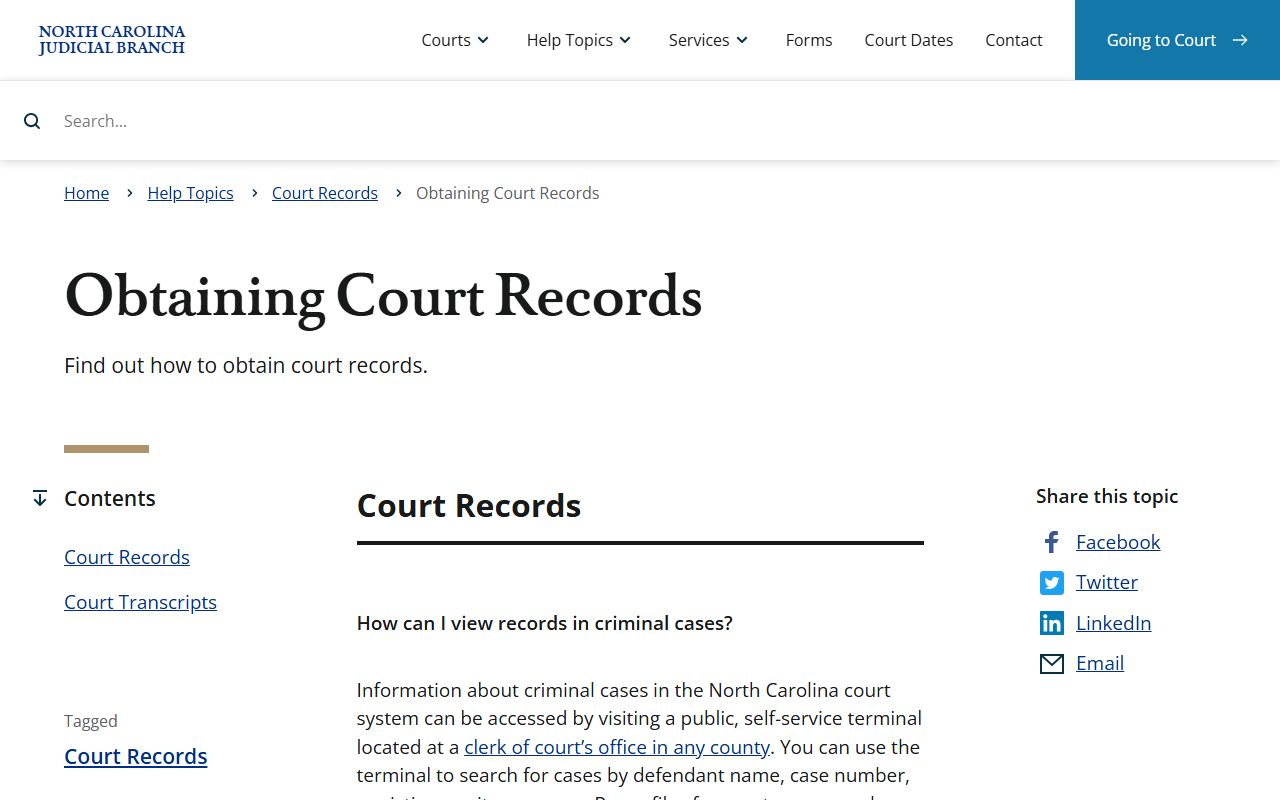
The North Carolina Judicial Branch publishes a court-records help page for finding case information, viewing files at the clerk's office, requesting copies, and understanding when police reports or expunction guidance are separate from the case file: Obtaining Court Records.
How Court Charges Get Filed After an Arrest
Booking does not prove that every listed arrest allegation will remain the court charge. In Yadkin County, criminal prosecutions are handled in Prosecutorial District 34. District Attorney Tom Horner's district includes Alleghany, Ashe, Wilkes, and Yadkin counties. The district attorney prosecutes criminal cases for the State, prepares the criminal trial docket, and advises law enforcement, but the office cannot give legal advice to a defendant.
A criminal case can begin or change through several charging documents. The exact document depends on the offense type, procedural posture, and court action. A returned arrest warrant, indictment, criminal summons, or nontestimonial identification order is generally public once returned to the court file, while investigative material can remain restricted under North Carolina law.
| Document | Typical Source | What It Does | Why It Matters After Arrest |
|---|---|---|---|
| Complaint or citation | Officer, magistrate process, or prosecutor review | States the alleged violation and starts a lower-level criminal matter | May be the first filed court record connected to the booking |
| Information | Prosecutor | Sets out a formal accusation without a grand-jury indictment where allowed | Can clarify what the State is actually pursuing after intake |
| Indictment | Grand jury | Formally charges an offense after grand-jury action | May replace or refine the booking charge in a felony case |
Charge Status in Court Records After Arrest
Charge status is a snapshot, not a final judgment. The charge shown during booking can be amended, reduced, dismissed, replaced by indictment, or resolved through a plea or trial. For that reason, court records after a jail arrest should be read by charge and by date. One case may include several counts, and each count can move differently.
| Status | What It Means | How to Read It |
|---|---|---|
| Pending | The charge has not reached a final disposition. | Check the next hearing date, bond order, and any recent filings. |
| Amended or reduced | The filed accusation changed from the earlier version. | Compare the booking charge, first court filing, and latest charge entry. |
| Dismissed | The charge was ended by court action or prosecutor action. | Confirm whether other counts in the same case remain open. |
| Nolle prosequi | The prosecutor declined to continue that charge at that time. | Do not treat it as a conviction; verify whether related charges continue. |
| Disposed | The charge has a recorded outcome. | Read the disposition, sentence, costs, and appeal status if listed. |
Bond and Release After an Arrest
Bond information sits between jail custody and court procedure. Yadkin County does not have a separate local bond payment page in the research materials. Call the Detention Center for current custody and bond status, and contact the Clerk of Superior Court or magistrates for procedural questions about court paperwork. Bond is not commissary money. Sending funds to an inmate account does not satisfy a secured bond or a release order.
| Bond Type | How It Works |
|---|---|
| Written promise or PR release | The person is released on a promise to appear without posting money, subject to the court's conditions. |
| Unsecured bond | No money is paid up front, but the person may owe the stated amount if they fail to appear. |
| Secured bond | Release requires cash, property, or a bondsman's surety accepted under court procedure. |
| No bond | The person is held without bond until a court or magistrate changes the status. |
| Hold or detainer | Another agency, sentence, warrant, probation matter, or immigration/federal issue may keep the person in custody even if the local charge has a bond. |
Recent public reporting shows how the pathway can work without making a broad rule from one case. In June 2026, sheriff compliance checks reportedly led to warrants, no-bond custody at the Yadkin County Detention Center, and later court appearances. In a separate 2025 breaking-and-entering report, no-bond detention and an initial court date were also part of the early case path. Those examples show why the jail, magistrate, clerk, and court calendar may each answer a different part of the same arrest question.
Warrants, Public Arrest Facts, and Court Records
Yadkin County Sheriff's Office patrol deputies serve arrest warrants and other criminal process. The magistrate's office in the courthouse issues criminal warrants, and the research materials identify a magistrate on duty around the clock. Once process is returned to court, returned arrest warrants, indictments, criminal summonses, and nontestimonial identification orders are public records unless another rule restricts access.
North Carolina General Statute 132-1.4 treats criminal investigation and intelligence records differently from ordinary public records, but it also identifies arrest information that must be available to the public. That public information can include the time, date, location, and circumstances of an arrest; the person's name, sex, age, address, employment, and alleged violation; the arresting or investigating officer; whether weapons or force were used; whether resistance or pursuit occurred; and 911 call contents, with caller identity protected in some circumstances. A complete investigative report may still be withheld unless discovery rules or another law requires release.
Charges vs. Convictions in Court Records After Arrest
An arrest and a filed charge are accusations. A conviction is a later outcome based on a guilty plea, verdict, or other court disposition that carries the legal effect of conviction. Court records after an arrest should not be summarized as a conviction record unless the docket or file actually shows that result.
| Charge | Conviction | |
|---|---|---|
| Stage | Accusation after arrest, citation, warrant, indictment, or other filing | Final or appealable outcome after plea, verdict, or qualifying disposition |
| Proof level | Based on probable cause or formal accusation standards | Requires proof beyond a reasonable doubt or a valid guilty plea |
| Record meaning | Shows what was alleged and filed | Shows the court's final criminal judgment on that charge |
| Can change | May be amended, reduced, dismissed, or replaced | May still be affected by appeal, later relief, or expunction eligibility |
Sealed vs. Expunged Arrest and Court Records
Restricted records require careful wording. Eligibility for sealing, expunction, or other record relief depends on the charge, disposition, criminal history, timing, and North Carolina law. The Clerk of Superior Court and Judicial Branch guidance can explain forms and filing procedures, but legal advice about eligibility should come from a qualified attorney.
| Sealed | Expunged | |
|---|---|---|
| Public visibility | Hidden or restricted from ordinary public access by court order or law | Removed from public access and treated under the governing expunction order |
| Agency access | Some agencies or courts may retain limited access depending on the order | Access after expunction depends on the statute and the specific order |
| Common trigger | Juvenile confidentiality, sealed filings, protective orders, or sensitive material | Dismissal, not-guilty outcome, certain eligible convictions, or other statutory categories |
| Practical step | Ask the clerk how access is restricted and what can be copied | Review Judicial Branch expunction guidance and case-specific legal advice |
Background Check Considerations
Public case lookups and clerk file searches are not the same as a regulated consumer background report. A person using criminal records for employment, housing, credit, insurance, tenant screening, or another Fair Credit Reporting Act covered purpose must use a legally compliant process and cannot rely on casual web searches or incomplete court snippets.
Important: Public case information is not a consumer report and cannot be used for FCRA-covered decisions.
Yadkin County Court Contacts After Arrest
Yadkin County is listed by the North Carolina Judicial Branch in Prosecutorial District 34, Superior Court District 34, and District Court District 34. The main courthouse and Clerk of Superior Court number is 336-679-3600. Other listed court contacts include Superior Court Judges at 336-651-4416, District Court Judges at 336-651-4412, the District Attorney at 336-679-3610, and Magistrates at 336-679-3619. The Detention Center's court-information direction points people to the Clerk of Superior Court for court questions.
Restricted Court Records After an Arrest in Yadkin County
Some arrest-related material is public, but not every related document is open. Juvenile matters, sealed filings, expunged records, protected victim information, confidential informant details, medical information, and active criminal-investigation records may be withheld or redacted. Police reports are requested from the law-enforcement agency, not from the court clerk, and a complete investigative report may remain nonpublic unless discovery, court order, or another rule requires disclosure. When a public case entry appears incomplete, the right follow-up is usually the Yadkin County Clerk for court files and the originating law-enforcement agency for arrest or incident records.